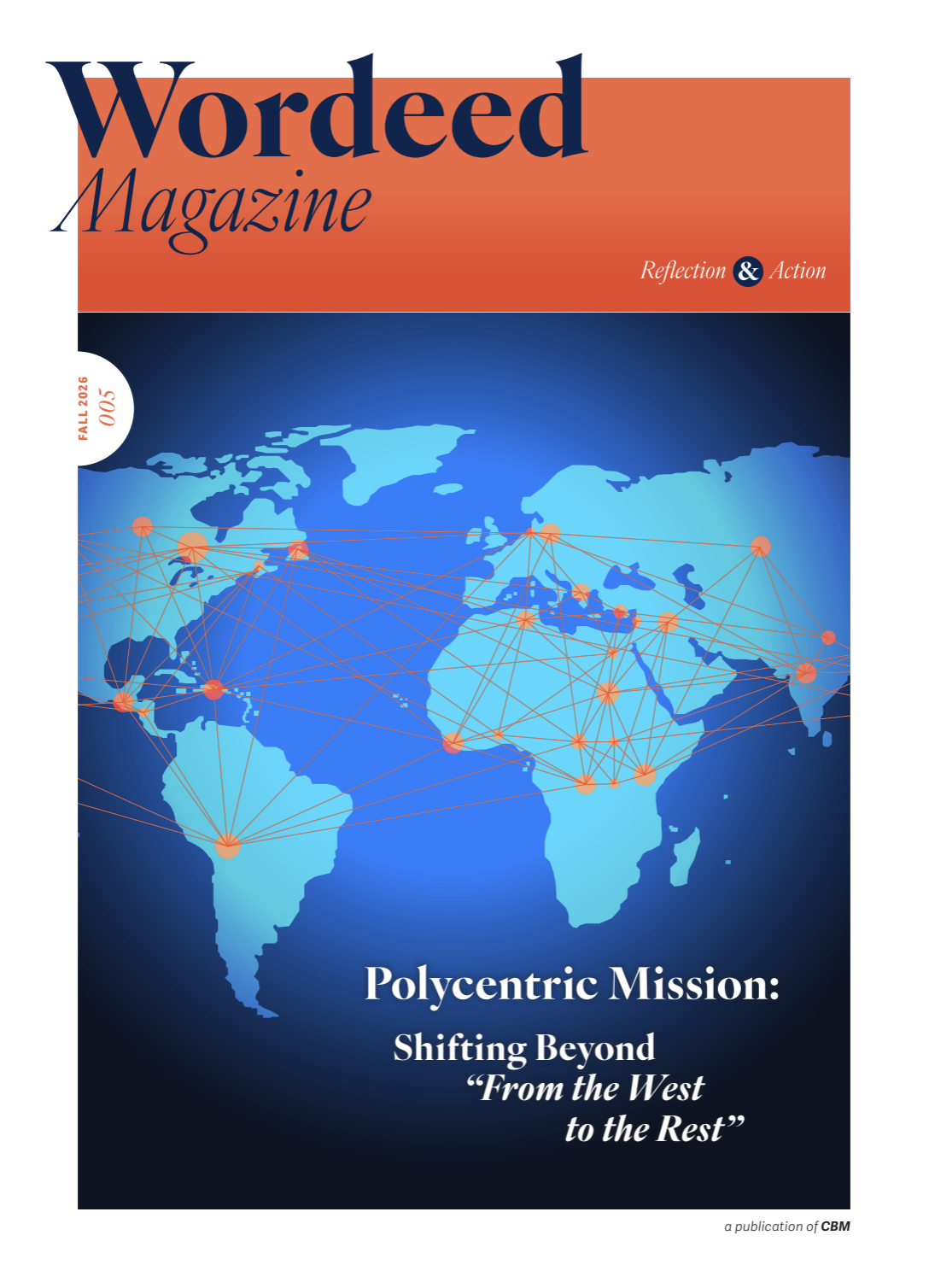

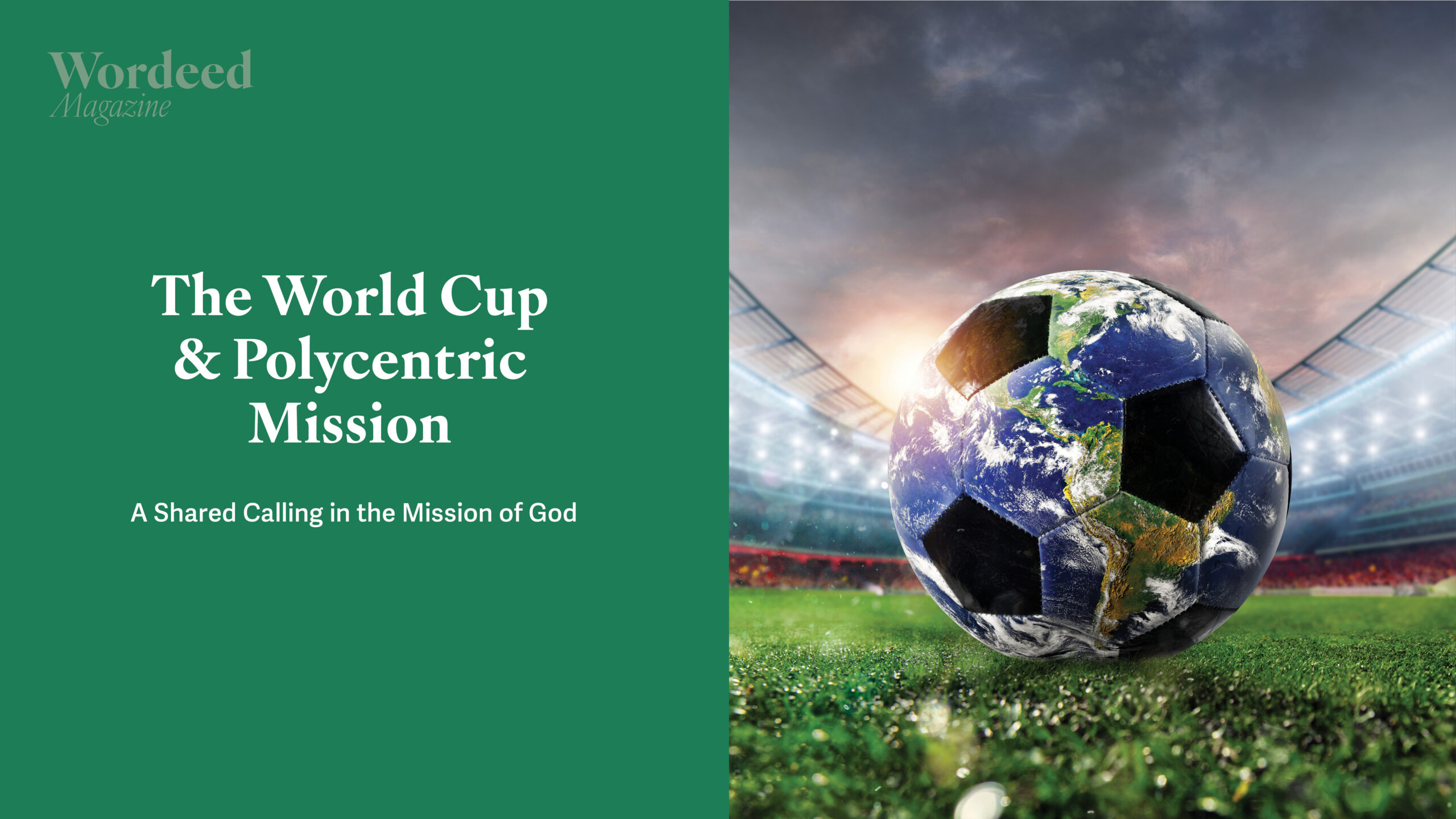
As the 2026 World Cup has just ended, it offers a timely lens for reflecting on polycentric mission through “the beautiful game.” Polycentric mission begins with a simple observation: God’s mission is no longer rightly imagined as moving from one dominant centre outward, but from many centres, in many directions, as the whole Church participates in the mission of God.
The World Cup may be one of the most polycentric events in the world. Football […] is one of the few global activities that draws the world’s attention and energy at once.”
The World Cup may be one of the most polycentric events in the world. Football (the proper word for the sport, despite Americans’ insistence on using that word for a game played mostly with hands!) is one of the few global activities that draws the world’s attention and energy at once. In some ways, sport functions like a religion: in its devotion, passion, money spent, and—dare I say it—the worship of a “pantheon” of celebrities. Yet sport can also inspire fellowship, camaraderie, integrity, community, and health. As with many human things, there is a mix of good and bad.
Polycentrism implies many centres. In my 2016 book, Polycentric Missiology, I look at five missiology conferences held to celebrate the centenary of the famous Edinburgh 1910 World Missionary Conference. In 1910, there was essentially one centre, and mission was largely understood as moving “from the West to the rest.” By 2010, mission had become “from everyone to everywhere,” with major mission-sending conferences in Tokyo, Edinburgh, Cape Town, Boston, and San José.
Today, we see Africans going to Europe, Brazilians going to the Middle East, Chinese Christians speaking of going “back to Jerusalem,” and intra-continental missions within India and sub-Saharan Africa. The Majority World—Africa, Asia, Latin America, and the rest of the non-Western world—is no longer simply the recipient of mission. It is increasingly the generator and sender of mission.
The ultimate Sender is God himself, who sends us through the Holy Spirit, just as the Father sent the Son.”
I am often asked whether mission can simply be “poly” without being “centric.” Some argue that centres create new forms of colonialism. Shouldn’t we divest ourselves of power rather than create new centres of power? Would that not simply swing the pendulum to the opposite extreme?
My answer begins with the word mission itself. The Latin mission and the Greek apostellō both carry the meaning “to be sent.” Sending implies a sender, which is usually some kind of centre. The ultimate Sender is God himself, who sends us through the Holy Spirit, just as the Father sent the Son. Paul also made his missionary journeys sent out from Antioch, which resourced him, prayed for him, and commissioned him. Whether that sending is carried by a congregation, bishop, pope, or monarch, a centre is necessary.
@Jonnypollock on X said, “Centrifugal energy without a centre becomes dispersal. We can talk endlessly about being ‘sent’ but fail to form people deeply in Scripture, doctrine, prayer, and holiness…When that happens, believers do not so much enter the culture on mission as dissolve into it.” This is insightful because centres not only fund but also educate and support.
William Carey, often called the “Father of Modern Missions,” had his friend Andrew Fuller back in England serve as his “rope holder.” The image comes from spelunking: the person who enters the cave ties a rope around their waist while a friend stands at the entrance holding the other end. If the explorer gets lost, they can follow the rope back to its source—the “centre”—or the rope holder can help pull them out. Centres are necessary for grounding because mission is never meant to be done alone.
Even in the Roman Catholic Church, often viewed as the prime example of a monocentric (Rome) structure, Pope Leo has recently reinvigorated the idea of synodality, as opposed to traditionalists who prefer monocentrism. Rather than clergy having one-way power over the laity, synodality points toward a flatter structure where clergy and laity listen to one another for mutual edification. Even a tradition strongly associated with one centre can recognize the need for
many centres.
Turning back to the World Cup, football was once understood as an English sport. The English invented the modern game, as they also gave the world rugby, cricket, and tennis. Football remains one of England’s most important athletic contributions to the world, which may explain why the English can be so angst-ridden whenever they do not win. It’s central to English identity. (Them crashing out in the semifinals again must have hurt!)
The Edinburgh 1910 World Missionary Conference represented a time when mission truly was “the West to the rest,” with the United Kingdom at the centre. But by the twenty-first century, “the rest” had become more Christian than the West. Likewise, football may have been invented in England, but other countries have become as good as, and often better than, the English. Football has become the world’s sport, no longer just Britain’s sport.
Another observation for this polycentric parallel is the visible diversity of “European” and “Western” national teams. Many of their most prominent players are Black, brown, or from immigrant backgrounds. This does make one rethink postcolonialism, as former colonial powers that once oppressed Majority World nations are now proud to use the athletic prowess of people from those same communities for national glory. France’s national team hero Kylian Mbappé is Black. The United States’ striker Folarin Balogun is Black. Yet Argentina’s national hero Lionel Messi, from one of the most southern nations represented in the World Cup, is white. What is called “Western” often has a Black or brown face in football.
So it goes with the Church. As Soong-Chan Rah argues in The Next Evangelicalism, North American Christianity may be declining in many white churches but growing in churches of colour. The largest church in London is Nigerian. Christianity is thriving among Indigenous peoples and island communities worldwide. Philip Jenkins famously said in The Next Christendom, “Soon, the phrase ‘a white Christian’ may sound like a curious oxymoron, as mildly surprising as ‘a Swedish Buddhist.’ Such people can exist, but a slight eccentricity is implied.” European soccer teams, without brown or Black players, would hardly make it as far as they currently do. And the U.S. would not be a majority-Christian nation without people of colour.
Christianity’s polycentric face is one of the best apologetics for it being the only truly global religion. After all, if there truly is a global God, don’t you think he would be worshipped by people everywhere rather than only by one nation, tribe, or culture? Just as football is the world’s game, Christianity is the world’s religion. It is deeply ironic when white Christians are unaccepting of immigration or ethnic diversity. A Christianity that mainly has a white face does not point to a global God, but a Western god.
As Christian nationalism rises in some places, Paul’s words in 1 Corinthians 12 become especially important. The Church is one body with many parts, and no part can say to another, “I don’t need you!” The parts that seem weaker are indispensable, and God gives greater honour to the parts that lacked it, “so that there should be no division in the body, but that its parts should have equal concern for each other.”
Just as football is the world’s game, Christianity is the world’s religion. It is deeply ironic when white Christians are unaccepting of immigration or ethnic diversity. A Christianity that mainly has a white face does not point to a global God, but a Western god.”
If Christianity is truly global, then mission must also be understood globally—not as the work of one centre, but as the shared calling of the whole body of Christ. That is the heart of polycentric mission: many centres, one body, and a shared calling in the mission of God.[/vc_column_text][/vc_column][/vc_row]