
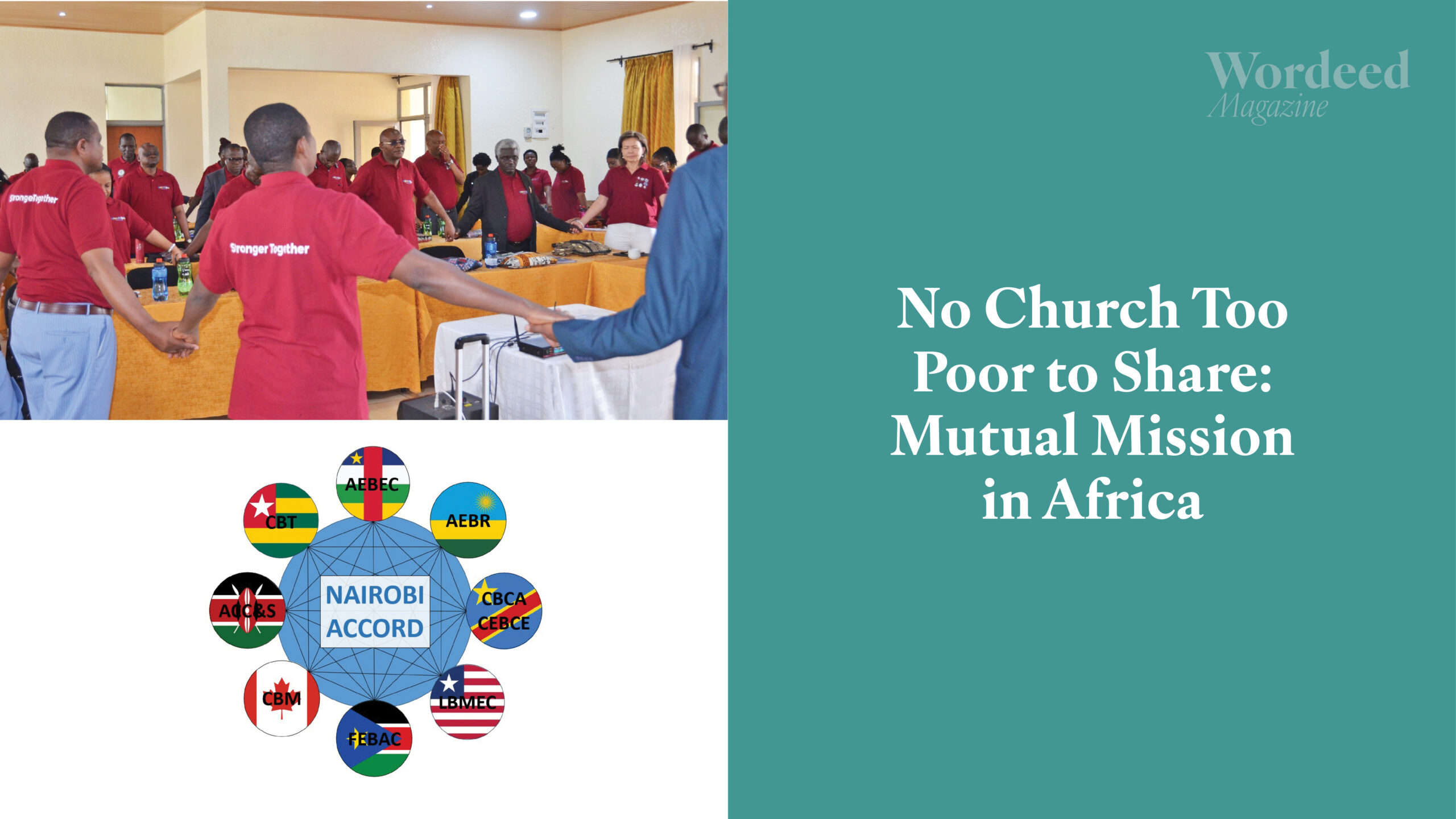
Among CBM’s African partner churches, a new expression of unity is taking shape through the Nairobi Accord.
The Accord opened a new era of mutual mission and named a shared desire for African churches to walk together, learn together, and respond together to the challenges facing their communities—not as isolated institutions, but as sisters in God’s mission.
At the heart of this shift is a simple but powerful conviction: no church is too rich to receive, and no church is too poor to share.”
At the heart of this shift is a simple but powerful conviction: no church is too rich to receive, and no church is too poor to share.
This matters deeply in Africa today. Partner churches are responding to hunger, conflict, climate change, displacement, ethnic tension, and patterns of dependency. These realities are pressing churches to seek deeper contextualization and home-grown solutions shaped by their own gifts, leadership, and lived experience.
Mission is more faithful when it is rooted in people’s lived realities, attentive to their needs and gifts, and shaped by local leadership.”
There is a saying in English: “We cannot direct the wind, but we can adapt the sails.”
In the same way, while the Missio Dei—the mission of God—belongs to God and does not change, we can read the signs of the times, keep a prophetic voice, and seek God’s guidance as we help the Church respond faithfully.
What needs to shift is not God’s mission, but the Church’s posture.
Mission is more faithful when it is rooted in people’s lived realities, attentive to their needs and gifts, and shaped by local leadership. In polycentric mission, every part of the global Church has something to give and something to receive.
A key starting point is unity. The affirmation that no church is too rich to receive and no church is too poor to share echoes African proverbs such as “Umoja ninguvu”—unity is power—and “Umugozi w’inyabutatu ntawawuca”—no one can cut three intertwined ropes.
These proverbs remind us that the body of Christ is strengthened when churches stand together. From this unity, sister churches can share resources, gifts, and responsibility. Together, they can address ethnic conflict, resist geopolitical manipulation, build bridges where politics divides, and respond to human suffering in light of the Missio Dei.
This does not exclude CBM, rather CBM is invited to join as a sister mission organization that contributes, learns, grows, and receives alongside African churches. Canadian Baptist churches are also invited to learn from and be enriched by African sisters and brothers.
This is what polycentric mission is beginning to look like in Africa: churches standing together, sharing responsibility, receiving from one another, and responding from within their own contexts. Mission does not move only from outside Africa into African communities. It also rises from within African churches.
No single region, institution, or tradition owns mission—that is God and God’s alone. Instead, the Missio Dei must unite Churches across borders and contexts.
We cannot direct the wind. But by God’s grace, and with the guidance of the Holy Spirit, we can adapt the sails together.